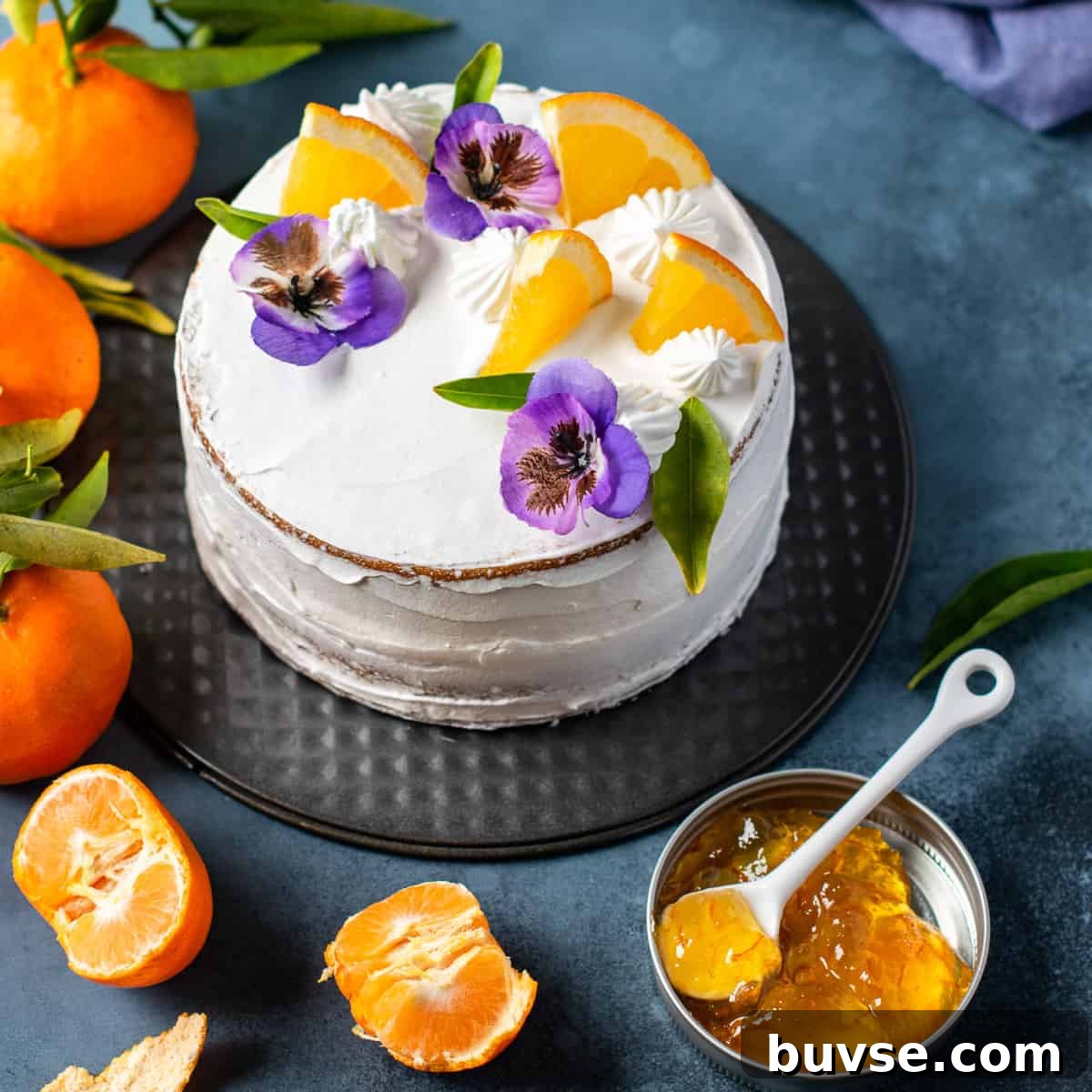
My eggless orange cake is bursting with bright citrus flavor from fresh orange juice and zest. It bakes up moist and tender without butter or eggs, making it a perfect tea-time treat. Serve it plain with coffee, or amplify the orange by layering with marmalade and a light frosting to create an irresistible Orange Dream Cake. A step-by-step video is included below.
If you enjoy fresh-fruit cakes, this orange sponge joins a collection of favorites: fresh strawberry cake with cream cheese frosting, eggless mango cake, and a holiday fruit cake that blends orange, nuts, and dried fruit.
Tea-time cake or a delightful dessert
This fragrant orange cake stays moist for days and makes a pleasant addition to afternoon tea or a relaxed dessert. I often skip frosting and enjoy a plain slice with coffee. For a simple but elegant presentation, spread marmalade and whipped cream or a light frosting between the layers, roughly cover the top and sides, and garnish with orange wedges or edible flowers for a rustic finish. Using marmalade boosts the orange flavor and keeps the cake tasting fresh.
If you prefer to make frosting at home, a sturdy mascarpone whipped cream or a cream cheese frosting pairs nicely. For convenience, you can use a store-bought whipped topping and marmalade; both work well for a quick finish.
Ingredients to make an orange cake at home
This cake is a variation of a classic eggless vanilla sponge, adapted to feature orange. I replace yogurt with a mix of milk and fresh orange juice and rely on zest and juice for natural flavor—no orange extract or condensed milk is required. The basic ingredients are flour and cornstarch (for a lighter crumb), sugar, oil, baking powder, baking soda, salt, milk, orange juice, and orange zest.
No orange extract required
When you use fresh orange zest and juice, an extract is unnecessary. Save the extract for recipes that don’t use fresh citrus. If you must skip fresh ingredients, a small amount of orange extract can be used as a substitute.
Possible substitutes
- Replace the all-purpose flour + cornstarch with cake flour for a finer crumb.
- If you must use store-bought orange juice, dilute it slightly (see details below) and adjust the sugar.
- Add chopped nuts for texture; toss them in a little flour before folding into the batter to prevent sinking.
How to make a vegan orange cake
- Use plant-based milk (soy, almond, oat) in place of dairy milk.
- Choose a vegan frosting if you plan to decorate the cake.
Important tips for the best homemade orange cake
- Orange zest is key — don’t skip it. Use only the orange-colored peel and avoid the bitter white pith.
- Zest the orange before peeling; it’s easier and cleaner.
- Do not overmix the batter; fold gently until just combined to keep the cake tender.
- Do not overbake. The cake is done when a toothpick comes out with a few moist crumbs, not raw batter.
- For extra orange intensity, spread marmalade on the layers and top.
- The flavor improves after resting; the cake often tastes best the next day.
What oranges to use
Use oranges that juice well and taste balanced—not overly tart. Keep some pulp for texture but remove any seeds. Valencia and navel oranges work well; small, sour clementines may be too tart for this recipe.
Use a Microplane for best zest
A fine Microplane grater yields the most aromatic zest. If you don’t have one, a small, sharp zester works; if you can’t zest at all, use about ½ teaspoon orange extract as a fallback.
Can I use readymade orange juice?
Yes, but commercial juice often contains added sugar and is thicker than fresh juice. If you use store-bought juice, dilute 3 tablespoons of juice with 1 tablespoon of water and reduce the sugar by 1 tablespoon to balance sweetness. Fresh-squeezed juice takes only a few minutes and gives the best flavor.
Pan size to use
- This recipe works well in two 6″ round pans for easy layering.
- Alternatively, use one 8″ round or square pan.
- You can convert the batter to cupcakes; bake time will be about 12–16 minutes.
Storage instructions
- An unfrosted cake can be stored at room temperature for up to 2 days.
- Properly wrapped in an airtight container, the cake will keep in the refrigerator for up to 5 days.
- Unfrosted cake freezes well for later use—wrap it tightly in plastic wrap and foil.
- Frosted cakes should always be refrigerated and are best eaten within 4 days.
How to freeze and defrost an orange cake
- To freeze, wrap an unfrosted cake several times in plastic wrap, then a layer of foil. Individual slices can be wrapped the same way.
- A frosted fresh-cream cake is not recommended for freezing.
- To defrost, move the cake from the freezer to the refrigerator overnight, or let a whole cake sit at room temperature for 3–4 hours (slices about 30 minutes). A microwave on defrost can also speed things up for single slices.
KEEP IN TOUCH – Follow the blog and subscribe to never miss a recipe.
Other fresh fruit cakes to try at home
- Moist Vegan Apple Cake
- Homemade Cherry Cake
- Eggless Mango Marble Cake
- Oats Berries Multigrain Muffins
- Eggless Black Forest Cake
Homemade Orange Cake Recipe
Eggless Orange Cake (Tea Time Cake)
This homemade eggless orange cake is moist, fluffy, and ideal for tea or casual gatherings. Made without eggs or butter and freezes well.

Prep Time: 10 minutes | Cook Time: 35 minutes | Total Time: 45 minutes | Servings: 12 | Calories: 177 kcal
Rating: 4.34 from 9 votes
Ingredients
Mix in one bowl
- ¾ cup organic sugar (or regular sugar of choice)
- ¾ cup milk
- ⅓ cup plus 1 tablespoon oil (flavorless oil of choice)
- ¼ cup fresh orange juice
- 1½ Tablespoon orange zest
- 1 teaspoon pure vanilla extract
Sift in another bowl
- 1½ cup all-purpose flour
- 2 tablespoon cornstarch
- 1¼ teaspoon baking powder
- ½ teaspoon baking soda
- ½ teaspoon salt
Instructions
- Preheat the oven to 350°F (180°C).
- Prepare two 6″ pans or one 8″ pan by lightly spraying oil, dusting with flour, and lining the base with parchment paper.
- In a bowl, combine the sugar with milk, oil, orange juice, orange zest, and vanilla. Whisk until the sugar has mostly dissolved.
- In a separate bowl, sift together the flour, cornstarch, baking powder, baking soda, and salt.
- Pour the wet ingredients into the dry ingredients and fold gently. Whisk with a handheld or electric whisk until the batter is smooth and lump-free, taking care not to overmix.
- Divide the batter between the prepared pans, tapping them lightly on the counter to release air bubbles.
- Bake for 30–35 minutes, checking at 30 minutes. A toothpick inserted in the center should come out with a few moist crumbs but not raw batter.
- Allow the cakes to rest in the pan for 10 minutes, then loosen the edges with a knife and invert onto a cooling rack. Remove the parchment from the top and cool completely before storing or frosting.
- For best flavor, cover and refrigerate overnight before filling or frosting; the orange taste intensifies with resting time.
Video
Notes
USA standard cup size used: 1 cup = 240 ml. Read the entire post for FAQs and extra tips. The recipe was tested without vinegar; if you see vinegar in older video footage, it can be ignored.
I layered this cake with store-bought marmalade and used a ready whipped topping for convenience. If making frosting at home, a sturdy mascarpone whipped cream or cream cheese frosting complements the cake well.
Substitutes and variations
- Use cake flour instead of AP flour + cornstarch for a finer crumb.
- Swap fresh juice for store-bought (dilute and reduce sugar as noted above).
- Add floured chopped nuts for texture.
- To make vegan, use plant-based milk and a vegan frosting.
Storing and freezing
- Unfrosted cake: room temperature up to 2 days, refrigerated up to 5 days in an airtight container.
- Freeze unfrosted cake tightly wrapped in plastic and foil; thaw overnight in the fridge.
- Do not freeze cakes with fresh cream frostings.
Tips recap
- Always use orange zest—the flavor comes mostly from the peel.
- If sugar is coarse, pulse it briefly to a finer texture.
- Do not overmix or overbake; the toothpick should show a few moist crumbs when done.
- Marmalade between layers boosts the orange flavor.
- Flavor improves after a day of resting.
Nutrition (per serving)
Calories: 177 kcal | Carbohydrates: 27 g | Protein: 2 g | Fat: 7 g | Sugar: 13 g | Sodium: 150 mg